Introduction: Capitalist Logic and Ecological Choice in a Digital Pastoral
Within the virtual economic system of Stardew Valley, the player’s choice between restoring the Community Center and joining JojaMart is not merely a moral decision at the narrative level — it represents a collision between two fundamentally different models of economic development and resource allocation strategies. The Community Center route (the “Bundle Route”) employs a barter mechanism that compels players to engage in full-spectrum, cross-industry production, constructing a decentralized agricultural model grounded in resource diversity. The Joja route, by contrast, treats gold as the sole universal equivalent, converting town infrastructure into purely capital-driven transactions through highly monetized means.
For a long time, community discourse has been dominated by a cognitive bias: the assumption that the Community Center route is “free” while the Joja route is “expensive.” This view consistently overlooks the enormous fixed-asset structure, liquidity traps, and high opportunity costs lurking beneath the Community Center route. Furthermore, with the release of version 1.6, the introduction of “Perfection Waivers” and the “Golden Joja Parrot” has further reinforced the Joja route’s systemic advantages in the pursuit of maximum efficiency — even allowing players to purchase their way to the game’s core achievement benchmarks.
This study aims to rigorously analyze the underlying economic logic of both paths through a combination of quantitative and qualitative methods. The report begins by deconstructing the Community Center’s hidden capital expenditures, then quantifies the Joja route’s speedrunning advantage in timeline planning, with a focused examination of class stratification in late-game automation device acquisition. Finally, it draws upon Marxist labor alienation theory and ecocritical frameworks to explore how this digital pastoralist narrative maps onto the profound contradictions between capital efficiency and pastoral fantasy in the real world.
Main Body
I. The Community Center Model: In-Kind Taxation, Resource Diversity, and Ecological Sunk Costs
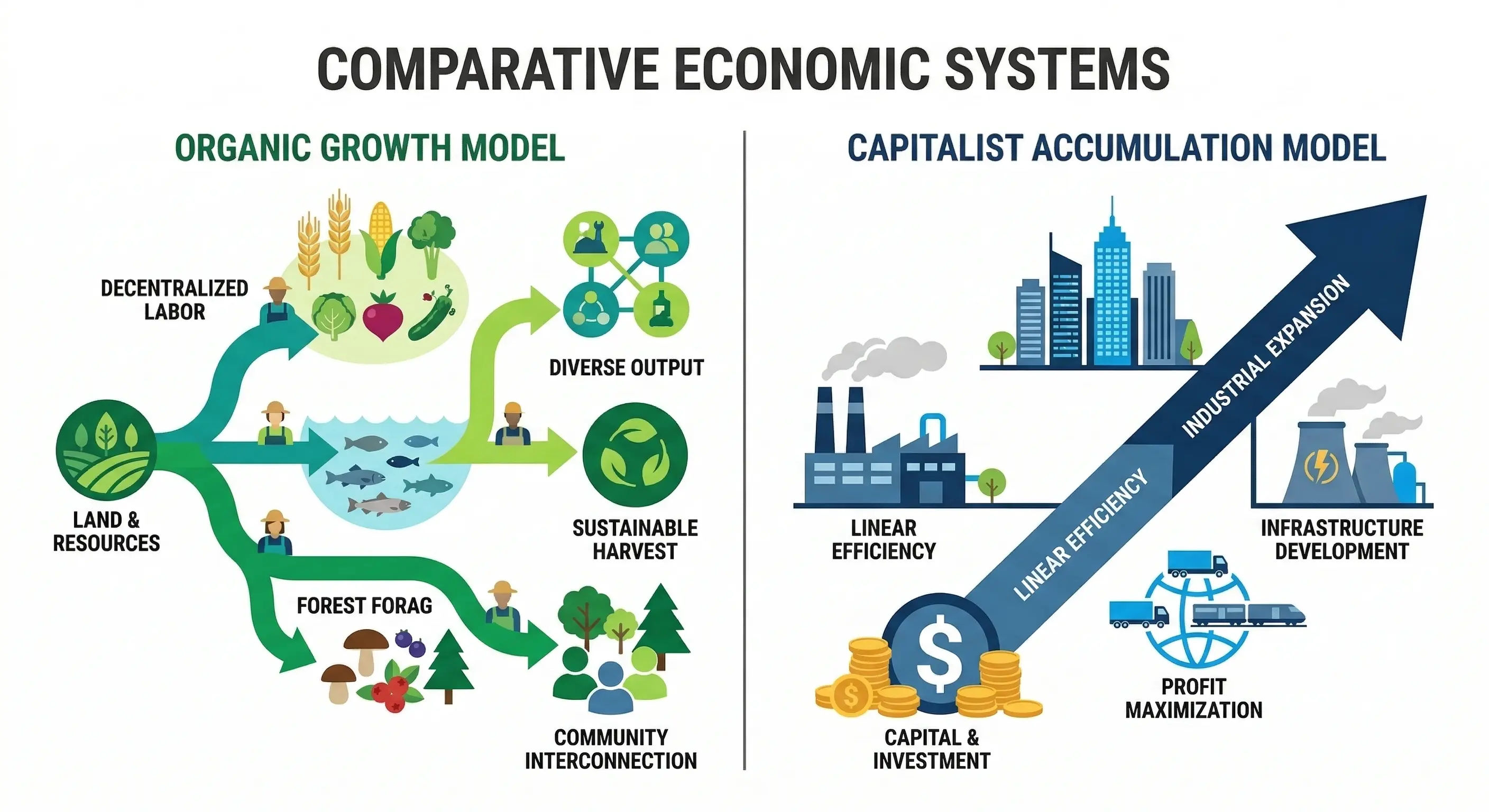
The core mechanic of the Community Center route is the “Bundle” system, which requires players to donate specific seasonal items of specific quality — crops, foraged goods, fish, and artisan products — to nature spirits called Junimos, in exchange for minor rewards and the gradual restoration of the town’s various infrastructure. Economically, this model is a textbook example of “in-kind taxation” and “mandatory resource diversification,” designed to force players to engage with every branch system in the game. Figure 1-1 defines the underlying models of both routes.
1. Mechanical Breakdown and Full-Industry Factor Binding
The Community Center route requires players to broadly engage in full-factor production across farming, foraging, fishing, mining, and animal husbandry — typically within the first or second in-game year. To illustrate the breadth and depth of this diversity requirement, the table below details the bundle requirements for each room and their corresponding infrastructure unlock rewards.
| Community Center Room | Sample In-Kind Collection Requirements | Corresponding Economic System & Hidden Requirements | Infrastructure Unlock Reward |
|---|---|---|---|
| Crafts Room | Specific wild plants from all four seasons (e.g., Wild Horseradish, Daffodil, Leek), Wood, and Hardwood. | Forces four-season foraging and exploration; requires axe upgrades to access the Secret Woods for Hardwood. | Repairs the bridge; unlocks the Quarry. |
| Pantry | Season-specific crops (including gold-quality Parsnip, Melon, Pumpkin, etc.), Large Milk, Large Brown Egg, Truffle Oil, Cloth, Apple, Pomegranate. | Forces diversified planting and fertilizer use to ensure quality ratings; forces construction of upgraded Barns and Coops; forces early planting of high-value fruit trees. | Reconstructs the Farm Greenhouse, enabling year-round, season-agnostic planting. |
| Fish Tank | Fish from rivers, lakes, and the ocean at specific weather conditions and times (e.g., Catfish, Sturgeon, Largemouth Bass, Sandfish); Crab Pot items. | Forces intensive, around-the-clock, cross-season fishing; Sandfish requires unlocking the Desert first. | Removes the glittering boulder near the mine entrance; unlocks the Panning feature. |
| Boiler Room | Copper Bar, Iron Bar, Gold Bar, Quartz, Earth Crystal, Frozen Tear, Slime, Bat Wing, Solar Essence. | Forces deep mine exploration and monster combat; requires descending to at least floor 80 of the mines. | Repairs the Minecarts; unlocks fast-travel nodes throughout the town. |
| Bulletin Board | Maple Syrup, Oak Resin, Pine Tar, Purple Mushroom, Duck Feather, Red Cabbage, Nautilus Shell, Fiddlehead Fern, Sea Urchin, Animal Fat, etc. | An extremely complex cross-system collection; heavily dependent on the Traveling Merchant’s random stock (especially Red Cabbage, which cannot be obtained through normal means in Year 1). | Increases all non-bachelor/bachelorette villagers’ friendship by 500 points (two hearts). |
| Vault | Four separate donations: 2,500g, 5,000g, 10,000g, 25,000g. | Pure capital accumulation; requires a total direct cash outflow of 42,500 gold. | Repairs the Bus Stop; unlocks transportation to the Calico Desert. |
The essence of this design is the deprivation of “focus rights.” As shown in Figure 1-2, players cannot concentrate their limited stamina and time on a single high-return industry. For example, to complete the Animal Bundle in the Pantry, players must simultaneously raise cows, sheep, pigs, chickens, ducks, and rabbits to obtain Large Milk, Duck Feathers, Truffles, and other specific products. This leads to severe fragmentation of farm space, making economies of scale impossible.
2. Opportunity Cost, Liquidity Traps, and the Sunk Cost Fallacy
From the perspective of economic efficiency maximization, the Community Center route carries extremely high opportunity costs. Players must retain items that could otherwise be sold or processed for added value. For instance, a gold-quality Pumpkin, a rare Sturgeon, or precious Truffle Oil donated to a bundle has its direct economic value wiped to zero, converted instead into progress points exchangeable for minor rewards (like a few seed packets or a Preserves Jar). This resource freeze creates a severe “liquidity trap.” In the early game, every gold coin and every point of energy is critical — yet vast amounts of potential capital are converted into non-tradeable, static progress, significantly slowing the farm’s early capital expansion.
Furthermore, the design of the Community Center bundles is particularly prone to triggering the “Sunk Cost Fallacy” identified in behavioral economics. Academic research notes that once players have invested significant time and resources into a specific bundle — for example, waiting an entire season to catch a seasonally-limited fish, or spending a fortune on a specific fruit tree — they develop a strong psychological compulsion to complete the remaining requirements, even when this is no longer the economically optimal decision. This mechanic resembles a Skinner Box, using staged micro-rewards to sustain long-term player engagement and retention, effectively transforming casual players into habitual hoarders.
3. Accumulation of Social Capital and the Redemption of Narrative Value
Despite its limited efficiency in pure monetary accumulation, the Community Center route offers significant “social capital” returns. Upon completing the Bulletin Board bundles, players receive a 500-point friendship increase with all met non-bachelor/bachelorette villagers — equivalent to a direct two-heart boost. This town-wide friendship surge is extremely valuable in the early game, dramatically accelerating the unlocking of villager-exclusive recipes and story events. It is worth noting that this reward has mechanical nuances: for example, Kent, who only arrives in Spring of Year 2, will not receive the friendship boost if the bundle is completed before his arrival, and the Dwarf cannot receive the boost without the Dwarvish Translation Guide.
From a narrative standpoint, the Community Center route aligns with the player’s emotional desire to “escape the city and rebuild a rural community.” Players restore the town’s historic buildings through their own labor, providing a sense of psychological compensation rooted in harmony with nature. Upon completing all bundles, players earn the “Local Legend” achievement, and — crowned as the Stardew Valley Hero — witness JojaMart close its doors and eventually be transformed into a Movie Theater. This powerful positive emotional feedback loop is the fundamental reason most players firmly choose the Community Center route on their first playthrough.
II. The JojaMart Model: Capitalization, Economies of Scale, and Fixed Returns
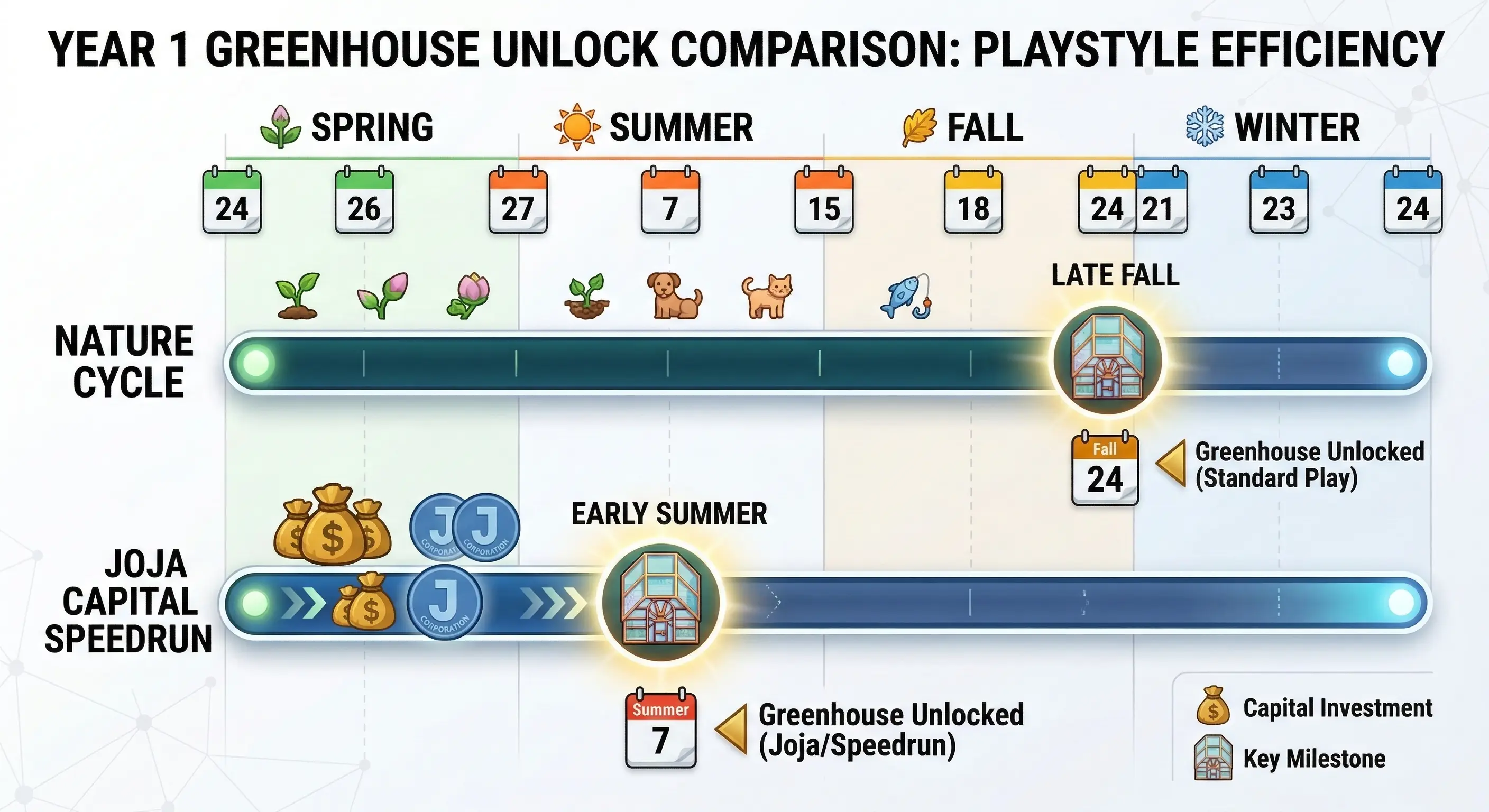
Unlike the Community Center’s cumbersome in-kind collection, the Joja route (unlocked after purchasing a 5,000-gold JojaMart Membership) converts all town restoration projects into pure capital transactions. In the “Joja Community Development Form,” gold becomes the sole universal equivalent, completely replacing the pre-modern barter model. Figure 1-3 presents an analysis of the Joja route’s timeline planning advantages.
1. Joja’s Cost Structure and De-Randomization
The Joja route’s pricing strategy is clear, transparent, and fixed — completely stripping away randomness (RNG) and seasonal constraints. All town infrastructure is priced explicitly; players simply pay the corresponding amount to JojaMart manager Morris, and Joja’s construction crew completes the restoration overnight.
| Joja Community Development Project | Cost (Gold) | Corresponding Community Center Room | Core Function Unlocked |
|---|---|---|---|
| JojaMart Membership | 5,000 | Prerequisite to unlock the Joja route | Converts the Community Center into a Joja Warehouse. |
| Minecarts | 15,000 | Boiler Room | Repairs Minecarts; unlocks fast travel. |
| Panning | 20,000 | Fish Tank | Removes the boulder near the mine entrance; unlocks Panning. |
| Bridge | 25,000 | Crafts Room | Repairs the mountain bridge; unlocks the Quarry. |
| Greenhouse | 35,000 | Pantry | Repairs the farm Greenhouse; enables year-round planting. |
| Bus | 40,000 | Vault | Repairs the Bus Stop; unlocks Calico Desert access. |
| Total Capital Expenditure | 140,000 | All Bundles | Full town revitalization and transportation unlocked. |
Additionally, JojaMart demonstrates the convenience of modern commerce through its operating hours: open from 9 AM to 11 PM daily, including Wednesdays, filling the gap left by Pierre’s General Store on its Wednesday closure. Regarding prices, while Joja’s seed prices are higher before membership, after purchasing the 5,000-gold membership, all seed prices at Joja match Pierre’s exactly — and Sunflower Seeds at Joja are priced at 100 gold, even lower than Pierre’s 200-gold price point.
2. Specialized Division of Labor and the “Fixed-Return” Empire
The Joja model grants players enormous strategic freedom through extreme specialization. Players are no longer led around by the nose by bundle requirements; they can entirely ignore gameplay systems of no interest to them. For players pursuing min-maxing, this means channeling all energy into a single, most-efficient production activity.
In the early game, the quintessential capital accumulation strategy is the “hardcore fishing build.” Since early spring crops yield thin margins and consume substantial stamina, seasoned players can spend the first dozen days of spring exclusively fishing in high-yield bodies of water (such as the mountain lake), forgoing farming entirely. Data analysis shows that skilled players can easily reach level 10 fishing by mid-spring and earn over 80,000 gold through the sale of high-quality fish. This substantial capital is then directly invested in Joja’s Greenhouse restoration (35,000 gold) and Bus restoration (40,000 gold), bypassing the primitive accumulation phase of agricultural capital entirely.
In the mid-to-late game, Joja-route players typically establish a “Fixed-Return Empire” centered on Starfruit or Ancient Fruit wine production. By filling the Greenhouse and Ginger Island with high-value crops and constructing massive kegging operations on the farm, players achieve the complete industrialization and capitalization of agricultural production. At this stage, weekly revenues of hundreds of thousands — or even millions — of gold in wine easily cover all remaining Joja Community Development Form costs. Players are completely liberated from the agricultural dependency on seasonal conditions, becoming financial magnates who control their own cash flows.
III. Quantifying the Economic Contest: Hidden Infrastructure Costs and the Liquidity Trap
Within Stardew Valley’s community discussions, a widespread cognitive bias exists: the Joja route’s 140,000-gold cost is perceived as an exorbitant “pay-to-win” expenditure, while the Community Center route is seen as “free.” However, upon rigorous economic deconstruction and cost accounting, the Community Center route’s hidden opportunity costs and infrastructure sunk costs actually far exceed the Joja route’s explicit expenditures.
1. The Community Center’s Hidden Fixed-Asset Structure
To complete the Community Center route, players must incur substantial mandatory expenditures on prerequisite infrastructure, constituting an enormous fixed-asset structure:
First, the Vault bundle itself requires players to directly contribute 42,500 gold in cash across installments — nearly one-third of the Joja route’s total cost (140,000 gold).
Second, the Animal Bundle constitutes the heaviest infrastructure burden. To obtain Large Milk, Large Brown Egg, Large Goat Milk, Duck Feather, Rabbit’s Foot, and Truffle, players must progressively upgrade their livestock buildings. Constructing and upgrading to a Deluxe Barn costs a total of 43,000 gold plus 1,350 Wood and 650 Stone; constructing and upgrading to a Deluxe Coop costs a total of 34,000 gold plus 1,200 Wood and 450 Stone. These two buildings alone represent a direct cash outlay of 77,000 gold. Players must then purchase the animals themselves: a Pig costs 16,000 gold; a Rabbit, 8,000 gold; a Duck, 4,000 gold; a Goat, 4,000 gold. Excluding the potential resale value of wood and stone, the hard capital expenditure required solely to meet the Animal Bundle exceeds 110,000 gold.
Third, the Artisan Bundle requires planting Apple and Pomegranate trees, both of which cost several thousand gold each and require a full season to mature before bearing fruit.
| Expenditure Dimension | Joja Route Direct Capital Outflow (Gold) | Community Center Hidden Capital Expenditure Estimate (Gold) |
|---|---|---|
| Direct gold payment | 140,000 (covers all projects) | 42,500 (Vault bundles only) |
| Livestock infrastructure investment | 0 (no mandatory requirement) | 77,000 (Deluxe Coop + Deluxe Barn) |
| Key animal acquisition costs | 0 (no mandatory requirement) | ~35,000 (Pig, Rabbit, Duck, Cow, Goat, etc.) |
| Fruit tree and special seed costs | 0 (no mandatory requirement) | ~10,000 (Apple/Pomegranate trees + gold-quality seasonal seeds) |
| Total Rigid Capital Outflow | 140,000 | ~164,500 (before accounting for the present value of wood and stone) |
The data in the table above clearly reveals a striking fact: even without counting the time cost of running around collecting specific items, the actual hard cash required merely to construct the physical farm infrastructure needed to satisfy the Community Center’s bundle conditions already far exceeds the 140,000-gold “protection fee” paid directly to Joja.
2. The Liquidity Trap and the Staggering Gap in Capital Turnover Rates
The greatest macroeconomic disadvantage of the Community Center route is its liquidity trap. Players must lock up large amounts of their precious early-game capital in fixed assets (such as fruit trees and animals) and bundle items that cannot be converted back to cash in the short term, severely slowing their early-game capital turnover rate. A piglet purchased for 16,000 gold takes 12 full in-game days to grow into a mature truffle-hunting pig — during which time that enormous sum is effectively frozen.
The Joja route, by contrast, keeps capital at maximum liquidity at all times. Players need not stockpile specific items for some distant seasonal bundle requirement; they can reinvest every unit of profit into the current highest-margin core crops (e.g., Strawberries in spring, Blueberries in summer, Cranberries in fall). This pure compound-interest growth model, free from all distractions, produces exponential snowballing of the Joja route’s economic output. The opportunity gains generated by leveraging this liquidity advantage in Year 1 alone would be sufficient to “buy” several Community Centers by year’s end.
IV. Progress and Timeline Competition: Greenhouse Unlock and the Speedrunning Matrix
For the hardcore player community pursuing efficiency and challenge, the critical breakthrough in Stardew Valley lies in how quickly two core facilities can be unlocked: the Greenhouse and the Desert Bus. Early access to these two facilities means players can launch the industrial-scale production of Ancient Fruit and Iridium several seasons ahead of schedule. On this dimension, the Joja route demonstrates an overwhelming, dominant advantage.
1. The Community Center’s Natural Time Chains
The Community Center route is absolutely constrained by the game’s natural seasonal cycles when it comes to timeline. Greenhouse access is firmly locked to the Pantry’s “Fall Crops Bundle” and “Animal Bundle.” This means that no matter how diligently players accumulate wealth during spring and summer, they cannot defy the laws of nature: they must wait for fall to plant and harvest Pumpkins, Yams, and Eggplants; they must wait for expensive pigs to spend over ten days growing into adults capable of foraging for Truffles on non-rainy days — or wait out a fruit tree’s entire season-long maturation cycle.
Consequently, without using specific exploits, the earliest possible Greenhouse unlock on the Community Center route is hard-locked to mid-fall of Year 1 (typically around Fall 13, when the relevant crops have matured).
2. The Joja Route’s Ultimate Speedrunning Matrix
The Joja route shatters this time chain entirely. With sufficient gold, players can walk into JojaMart on any morning, slam down 35,000 gold to unlock the Greenhouse, and immediately follow up with 40,000 gold to unlock the Bus.
According to the latest min-maxing analyses (such as version 1.6-based speedrunning guides), top-tier players can, through extreme spring fishing combined with mine diving, amass over 100,000 gold by late spring to early summer. They can pay to unlock both the Greenhouse and the Bus as early as the first week of Summer.
What does unlocking the Greenhouse and Desert a full season early (Summer versus Fall) actually mean? It means players can plant their first Ancient Seeds in the Greenhouse during Summer, using those three extra months to propagate Ancient Fruit seeds via Seed Makers throughout the entire Greenhouse, and enter full-scale winemaking mode by Fall. It means players can enter the Skull Cavern with bombs in hand during Summer, grinding Iridium and Prismatic Shards to achieve financial freedom within Year 1 itself. Time is money — and the Joja route allows players to use money to buy time. This is a divide the Community Center can never bridge.
V. Late-Game Automation and Class Stratification: The Auto-Petter and the Ultimate Capital Endgame
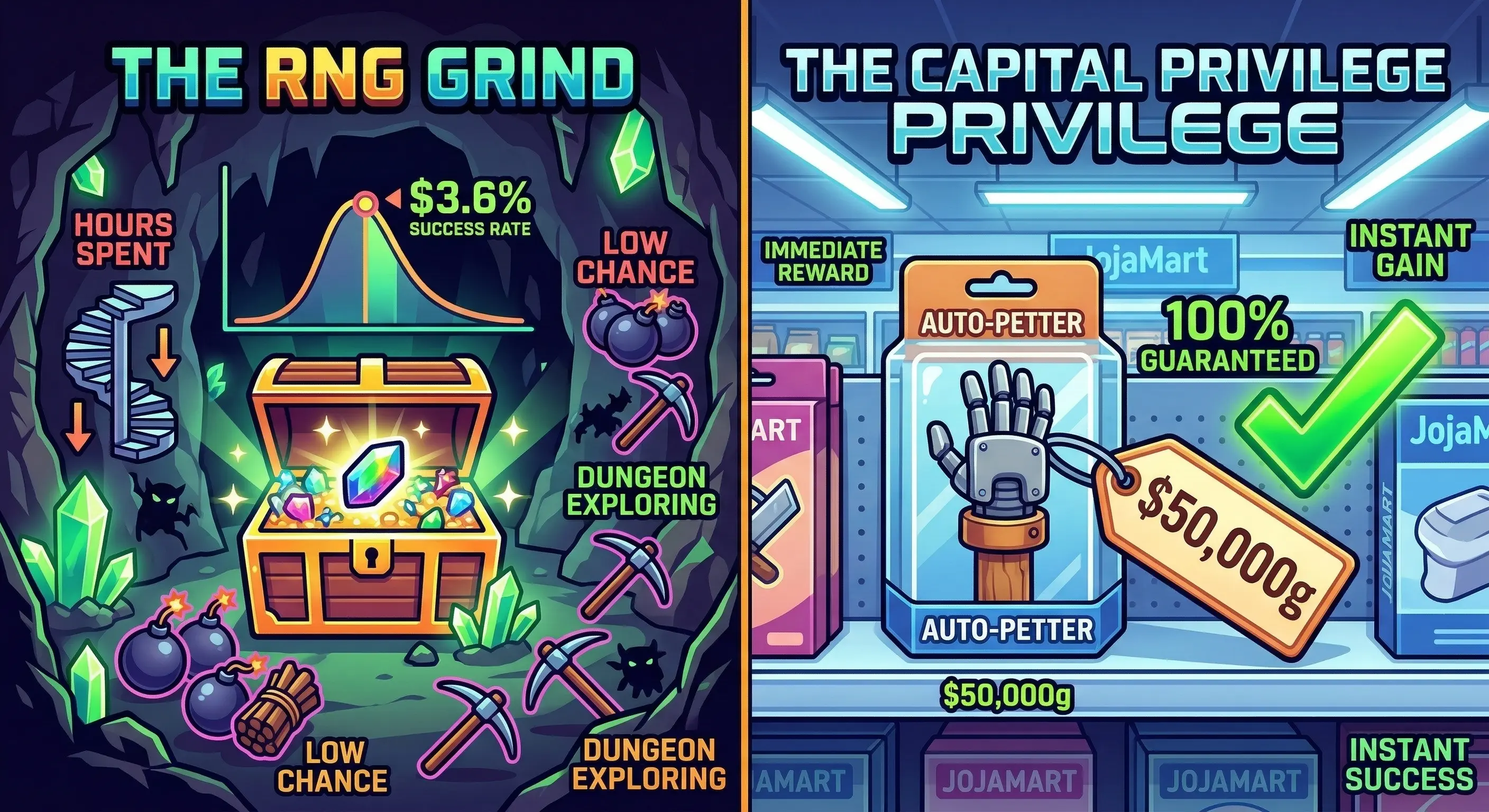
As the game advances to the late stages (Year 3 and beyond), player attention shifts from initial farm building to Ginger Island development, Skull Cavern deep dives, and achieving Perfection. At this point, large-scale animal husbandry creates enormous “daily maintenance time costs.” Manually petting dozens or even hundreds of animals every day to maintain their product quality consumes precious in-game time. The emergence of the Auto-Petter perfectly encapsulates the profound class stratification in “labor liberation” that the two routes produce. Figure 1-4 illustrates how the mechanic empowers Joja players with a class advantage.
1. The Auto-Petter’s Functional Role
The Auto-Petter is an automation device placed inside a Barn or Coop that automatically provides a petting effect to all animals within range each day. While the hidden friendship points it provides (8 points) are only half those of a manual pet (15 points), its core value lies in absolutely preventing the decay of animal mood and friendship values. For players commanding a vast “Truffle Pig Empire,” the Auto-Petter is the final piece of the puzzle enabling complete passive income automation on the farm. It allows players to leave the farm entirely and adventure for days on end without worrying about animal strikes.
2. The Absolute Certainty of Capital vs. the Probabilistic Exploitation of the In-Kind Model
In the manner of acquiring the Auto-Petter, the game’s design manifests an extremely powerful class metaphor — and is the single most important reason that many veterans firmly switch to the Joja camp on their second playthrough.
-
The Joja Route’s Class Privilege: For Joja members, after completing the entire Community Development Form, the Auto-Petter is placed on store shelves as a regular commodity. Players can walk to the register at any time and purchase as many as they want for 50,000 gold each. For a late-game capitalist pulling in millions of gold per week, 50,000 gold is a rounding error. This once again validates the logical advantage of capitalism — as long as you have money, you can buy your way out of any inconvenience and achieve absolute certainty.
-
The Community Center Route’s Probabilistic Hard Labor: If a player chose the noble Community Center path and drove out Joja, they permanently forfeit the right to purchase an Auto-Petter with gold. Players who chose the Bundle Route must instead submit to an extremely brutal game of chance (RNG). The primary acquisition method is hoping for a Treasure Room to appear while challenging the unfathomable Skull Cavern — and according to datamining, the base probability of obtaining an Auto-Petter from a treasure chest is a mere 3.6%.
| Route | Auto-Petter Acquisition Method | Single Unit Cost Estimate | Probability & Hidden Time Cost Analysis |
|---|---|---|---|
| Joja Route | Direct store purchase | 50,000 gold, absolutely fixed | 0% failure rate, zero time cost, buy and use immediately. |
| Community Center Route | Skull Cavern Treasure Rooms (3.6% chance); Golden Mystery Box (0.5% chance) | Cannot be directly purchased | Extremely high time depreciation rate. Requires consuming massive quantities of stone to craft hundreds of Staircases, eating expensive luck-boosting food (e.g., Magic Rock Candy), and repeatedly diving into the mine on high-luck days. If it doesn’t drop, players must employ “reset the day” tactics to avoid losses. |
In the pursuit of enough Auto-Petters to fill all their barns, countless players who originally sought a pastoral idyll are forced to become merciless bomb-mining machines in the Skull Cavern, day after day subjected to the torment of random numbers in the deepest tunnels. This agonizingly painful endgame experience constitutes a cruel gameplay punishment for those who initially chose the “moral high ground” — and inadvertently demonstrates the irreplaceable superiority of the Joja route when pursuing systemic efficiency.
VI. Version 1.6 Restructuring: The Full Ascendancy of Joja Capitalism and the Macronarrative
Stardew Valley’s version 1.6 update was an epic overhaul that introduced a wealth of late-game mechanics, decorative items, and quality-of-life (QoL) changes. A careful examination of these patch notes reveals that version 1.6 provided extremely powerful mechanical tilts and value boosts to the Joja route at the system level, pushing the logic of “capital solves everything” to its absolute limits.
1. Perfection Waivers: Buying the Final Achievement with Capital
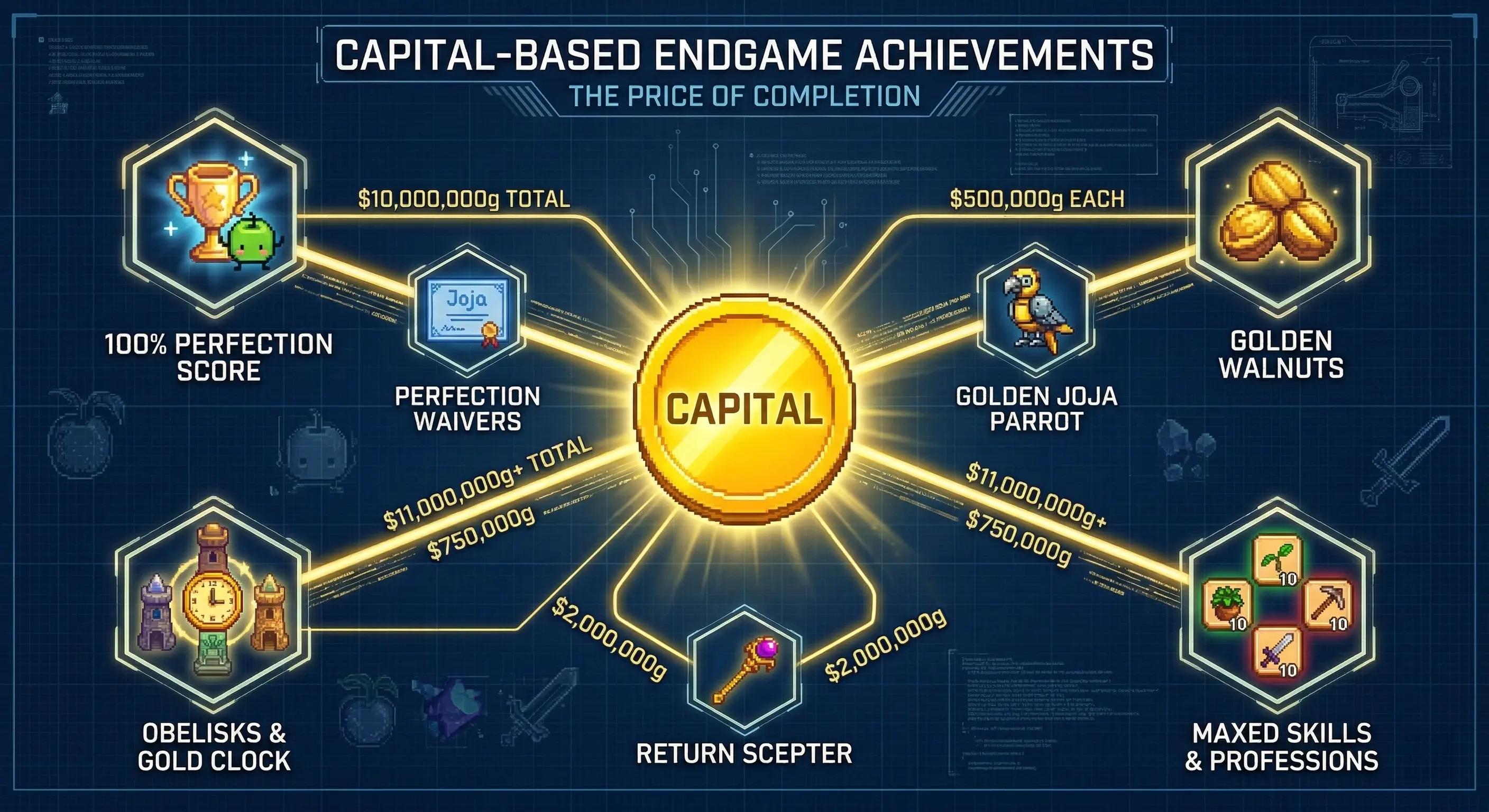
In version 1.6, after players unlock Mr. Qi’s Walnut Room on Ginger Island and consult the Perfection Tracker, a secret storyline triggers: a coded message from Fizz, an employee of the Joja Special Services Division. This black-market dealer, hiding in the island’s mushroom cave, peddles a item called the “Perfection Waiver.” At the staggering price of 500,000 gold per unit, its effect is equally astonishing — each one purchased directly ignores all incomplete in-game challenges and forcibly increases the Perfection Score by 1%.
The introduction of this mechanic constitutes a complete subversion of Stardew Valley’s long-standing tradition of “full-collection perfect endings.” Previously, achieving 100% Perfection required players to invest enormous effort into completing all cooking recipes, crafting all items, catching every variety of fish, and ultimately spending 10,000,000 gold to purchase the Golden Clock. The existence of Perfection Waivers declares that capitalist corruption has reached its zenith: players can even bribe the game’s own system mechanics to paper over their unfinished efforts.
From a purely economic standpoint, this is an extraordinarily cost-effective transaction. Building the Obelisks and the Golden Clock requires 13,000,000 gold and provides 14% Perfection; purchasing 14 Perfection Waivers from Fizz costs only 7,000,000 gold. A savings of 6,000,000 gold and countless grueling late nights makes the Perfection Waiver the ultimate shortcut for hardcore Joja speedrunners achieving a “paid 100%.“
2. The Golden Joja Parrot: The Monetization of Exploration
The “Golden Walnut Hunt” on Ginger Island was once a hardcore system requiring mandatory exploration, puzzle-solving, and sheer luck — 130 walnuts scattered across every corner of the island, deep inside the volcano, and hidden within the harvest chances of specific crops. Version 1.6 introduced a “Golden Joja Parrot” to the left of the volcano entrance. Players can pay 10,000 gold per walnut for the parrot to locate all remaining undiscovered walnuts by the next morning.
This feature is, in essence, the conversion of a player’s tedious puzzle-solving time into a pure gold expenditure. If you’re stuck in the late game, desperately unable to find the last 10 walnuts, you simply pay a 100,000-gold “information fee,” go to sleep, and wake up to find Joja’s airdrop package has filled every gap. Amusingly, the system deliberately flashes a warning at this point: “Doing so will prevent you from experiencing Ginger Island authentically.” This fourth-wall-breaking jab is a perfect satirical commentary on the process of alienation by which players sacrifice the inherent joy of the game for the sake of efficiency.
Combining sections 6.1 and 6.2, Figure 1-5 demonstrates how version 1.6 has thoroughly monetized “gameplay experience and exploration.”
3. Joja Cola’s Micro-Level Kinetic Boost and the Catalogue War
Beyond macro asset restructuring, version 1.6 also adjusted micro-level items. The “Joja Cola,” long dismissed as a trash-tier drink, received a key combat and daily movement buff: drinking it now provides a “Speed +1” effect lasting 21 seconds. Combined with the Joja-route-exclusive Soda Machine (which produces one Joja Cola free each day), Joja-route players gain a near-zero-cost, sustainably-supplied micro speed boost for extreme mine-clearing runs and farm cross-map operations.
To balance the decorative and collectible value of both routes, version 1.6 also released two furniture catalogues representing starkly different ideologies — and the acquisition barrier once again heavily favors Joja’s capital convenience:
-
Joja Furniture Catalogue: Available for direct purchase at JojaMart after completing the Joja route for 25,000 gold, offering a full set of furniture with a distinctly modern, corporate sci-fi, cold-cubicle aesthetic. Community Center players who want access must rely on a 10% chance spawn at the Traveling Merchant, at an elevated price of 30,000 gold.
-
Junimo Catalogue: An exclusive furniture set imbued with the energy of the nature spirits. Available to players of both routes after completion via the Traveling Merchant for 70,000 gold (also with only a 10% spawn chance).
These accumulated mechanical details all quietly signal to players: choosing Joja means not only monetary efficiency, but also enjoying the comprehensive privileges of the capital conglomerate — from macroscopic achievement benchmarking all the way down to micro-level travel speed enhancements.
VII. Philosophical Reflection and Sociological Critique: Labor Alienation, Commodity Fetishism, and Digital Pastoralism
The Joja vs. Community Center debate in Stardew Valley has long transcended a mere numbers game, touching profoundly on the grand themes of sociology, environmental ethics, and political economy. While the game’s narrative frames the Community Center as the mainstream “righteous path,” its deeper systemic mechanics are riddled with thought-provoking, counter-intuitive tensions.
1. The Marxist Perspective: Labor Alienation and the Ironic Cycle of Commodity Fetishism
In his Economic and Philosophic Manuscripts of 1844, Karl Marx proposed his famous theory of “Alienated Labor,” arguing that under capitalism, workers become estranged from the products of their labor, from the labor process itself, and from their own human essence. The game’s sweeping opening cutscene — depicting players mindlessly hammering keyboards like zombies in Joja Corp’s suffocating cubicles — is a vivid visual metaphor for the extreme alienation of modern life.
Players quit their jobs and move to the countryside to inherit a farm, driven at their core by the desire to find liberation through “non-alienated labor.” In the Community Center’s pastoral fantasy, players personally plant Parsnips and dive into deep waters to catch specific fish; the fruits of their labor are no longer abstract surplus value but are directly transformed into bundle items with real “use-value.” Through this act of barter, players attempt to rebuild the organic connection between humanity and nature, and between humanity and community — connections severed by capital.
And yet, when you gaze long enough into the abyss, the abyss gazes back. Even on the noble Community Center path, Marx’s “Commodity Fetishism” haunts these digital fields. To complete the enormous Vault bundle and meet the hidden infrastructure requirements, players inevitably get drawn into an endless cycle of efficiency optimization. Once a player chooses the Joja route, this alienation is fully exposed: the farm rapidly degenerates into a capital appreciation machine pursuing only “exchange-value.” The fields no longer contain the diverse crops of four seasons; instead, they are replaced by endless, highly homogeneous matrices of Ancient Fruit. Kegs and Preserve Jars rumble day and night; all output exists solely to increase the cold number in the top-right corner. At this point, players transform from submissive “wage slaves” at the bottom of Joja Corp into a new generation of capitalists who ruthlessly exploit land resources and automated labor (even trapping the Junimos in a hut to serve as free harvesting workers). This dark irony — “in fleeing from the mega-corporation, one ultimately becomes the very kind of ruthless monopolistic magnate one originally fled” — constitutes the sharpest possible critique of the all-pervasive logic of contemporary capitalism.
2. Ecocriticism and the Illusion of Digital Pastoralism
From the perspective of ecocriticism and environmental ethics, Stardew Valley constructs an enticing “Digital Pastoralism” utopia for a Generation Z tormented by ecological anxiety and urban involution. Environmental scholars observe that the Community Center model superficially advocates for a sustainable, season-respecting “degrowth” economics. The game, through its bundle mechanics, constrains players from engaging in extractive resource plunder, encouraging a dynamic balance with the natural ecosystem.
However, the Joja route — and the “maximum yield” playstyles it gives rise to — tears away this pastoral disguise without mercy. In the Joja player’s worldview, the natural environment is completely instrumentalized. The farm is no longer a habitat of harmonious coexistence between flora and fauna, but the most efficiently utilized spatial grid; the forest is merely a fuel depot from which resin can be extracted; the rivers are simply capital dispensers for primitive accumulation in the early game. This playstyle mirrors the real-world reality in which people, despite longing to return to nature, inevitably slip toward the consumerist abyss when confronted with the temptation of capital efficiency and convenience.
3. Ludonarrative Dissonance and the Moral Reckoning of the “Lesser Evil”
At the level of narrative ethics, a significant portion of the player community has mounted fierce criticism against the game’s preset mainstream narrative that “restoring the Community Center is absolute justice,” pointing to severe “ludonarrative dissonance.”
First, there is the Community Center’s utilization crisis. After players spend one or two years painstakingly restoring the grand Community Center, the building sits largely empty in the actual late game. The vast majority of villagers continue on their original life routines and rarely genuinely use this space, greatly undermining the player’s sense of accomplishment. Worse, because the blacksmith Clint wanders over to the Community Center on Fridays, players are unable to upgrade their tools on that day — a purely negative consequence that borders on comedy.
Second, there is Pierre’s hypocrisy and monopoly controversy. After driving out Joja, grocer Pierre becomes the sole retail hegemon of the town, achieving a complete monopoly and beginning to operate year-round without days off. Pierre is exposed in multiple game details as an extremely self-interested, profiteering capitalist (for example, he resells at markup the high-quality crops players sell to him, claiming to villagers that he grew them himself). Many economically-minded players argue that inviting external competition through Joja — breaking Pierre’s monopoly and profiting from the price war between them — is actually the “lesser of two evils” genuinely conducive to the town’s long-term development and free-market principles.
Finally, there is the moral dilemma of working-class employment. Destroying JojaMart directly causes marginal town characters Shane and Sam to lose the cashier and warehouse jobs they depend on to survive. As Shane himself says in the game, although he despises his working environment at Joja, the economic despair of unemployment would be a far deadlier blow. This storyline — where one destroys someone else’s livelihood in the name of sentiment — grants the Joja route a high degree of moral legitimacy in the eyes of many multi-playthrough veterans: a pragmatic, efficient, employment-providing option that carries no moral condescension.
VIII. Conclusion
On the surface, the Community Center vs. Joja route debate in Stardew Valley is a pastoral narrative about the survival and revival of a small town. At its deepest structural level, however, it is the game’s designer Eric Barone (ConcernedApe) presenting players with two precisely constructed, unforgiving laboratories for economic and sociological experimentation.
The Community Center model (in-kind harvest route) is a coercive ecological education system dressed in warm and tender clothing. Through deliberately engineered liquidity traps, lengthy seasonal cycle locks, and maddening probabilistic drops, it forcibly pins players into a slow-paced agricultural life. Its inefficiency is intentional — designed to pit abundant micro-achievements, deep emotional bonds with NPCs, and the moral high ground of ecological coexistence against the restlessness that runs deep in the modern soul. It forms the spiritual core of what makes this game feel “cozy.”
The Joja model (fixed-capital route), by contrast, strips away all romantic pretense and throws open the doors of capital operation to pragmatists who pursue maximum efficiency, precise calculation, and control. Its explicitly priced 140,000 gold shatters the shackles of time and season, granting players the power to achieve financial freedom rapidly through economies of scale and specialized division of labor. From the consistently stocked Auto-Petter, to the version 1.6 Perfection Waivers and Golden Parrot that allow players to bribe the game’s own system limits with cash, the Joja route embodies the realist doctrine that “capital levels all suffering” with ruthless thoroughness.
Neither system is absolutely right or wrong — they represent only a collision and iteration of values. From the passionate yearning for pure nature upon first entering Stardew Valley, to the seasoned veteran who, without hesitation, drops a stack of gold on Morris’s counter in the name of efficiency, the trajectory of player choices perfectly mirrors the real human struggle in modern society: the perpetual fight to survive between moral idealism and economic pragmatism. In every cycle of planting and trading, this great digital text asks, in silence: in this refuge we fled to from the modern city, are we truly searching for a lost soul — or merely rebuilding, in a different form, the very cage that once imprisoned us?